Home / Case Studies / SaaS Financial Model & Series A Fundraising Plan
CASE STUDY
InteractiveSaaS Financial Model & Series A Fundraising Plan
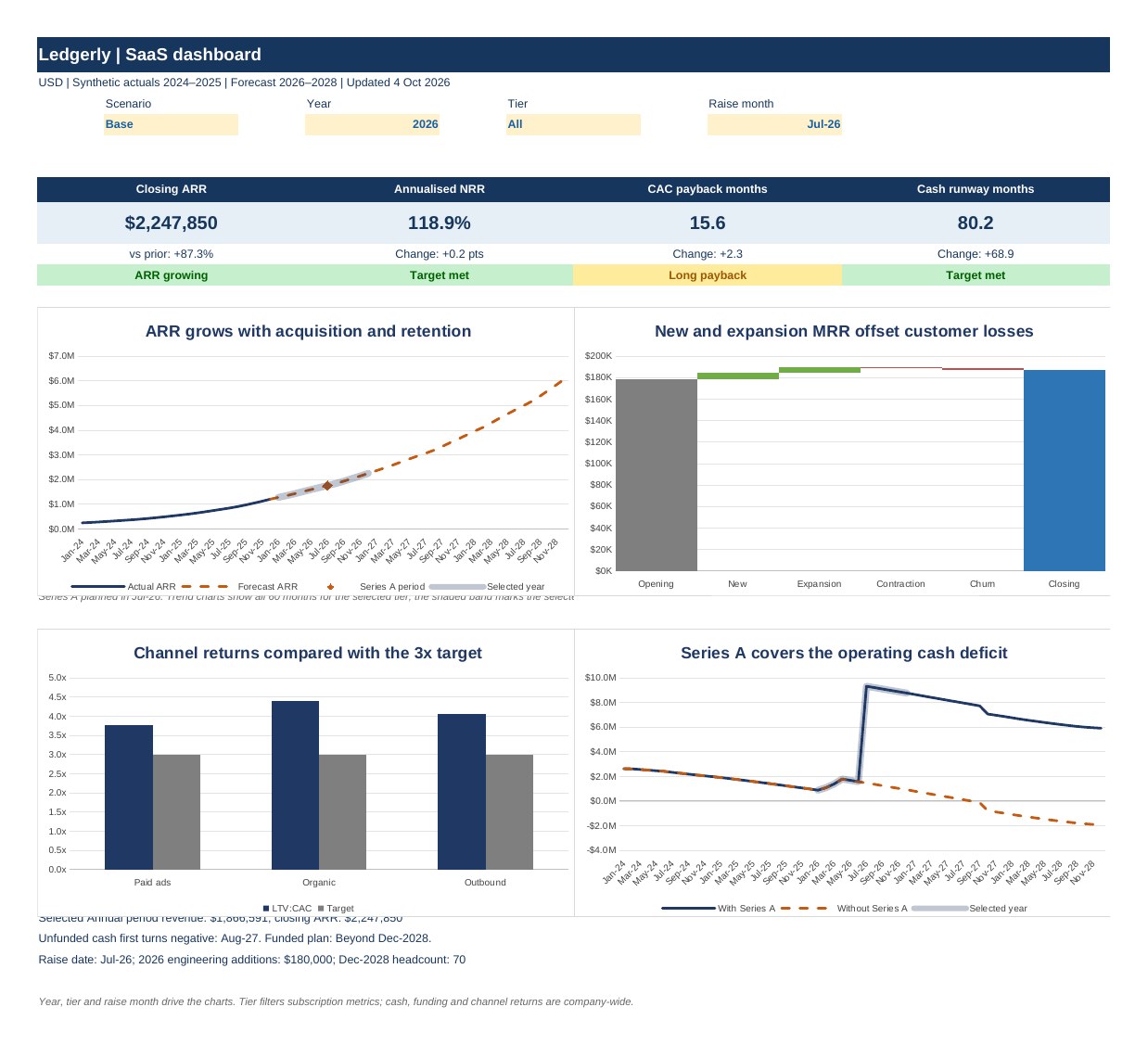
A five-year monthly SaaS model that links tiers, channels and cohorts to the three statements and shows runway with and without an $8m Series A.
Example engagement – illustrative figures
Business challenge
A SaaS founder preparing a Series A typically needs one model that connects pricing, acquisition and retention to cash, and answers investors' questions on runway, unit economics and dilution.
Outcome
Founders can show investors when cash runs out, how far the round takes the company and which tiers and channels earn back their acquisition cost, then test the plan against weaker cases before the pitch.
Overview
A five-year monthly model for a B2B SaaS start-up preparing a Series A. Pricing tiers, customer acquisition by channel, churn and expansion drive MRR and ARR, and hiring, hosting and overheads drive costs. Deferred revenue, capitalised development, the office lease, share options and expected credit loss flow into a linked income statement, balance sheet and cash flow. Two SAFEs and a bridge note raised in early 2026 convert at the Series A, and a fundraising section shows cash, burn multiple and runway with and without the raise, the planned use of funds and the fully diluted cap table. How to use this model: On the Dashboard sheet, choose the scenario in cell D6 (Base, Upside or Downside), the year in G6, the pricing tier in J6 and the Series A month in M6; the year moves the KPIs, the MRR bridge and channel returns, and is shaded on the ARR and cash trend charts; the tier filters ARR and subscription metrics; on the Fundraising sheet, compare closing cash, funding gap and runway with and without the Series A; on the Cash Sensitivity sheet, read December 2028 cash across a five-by-five grid of acquisition cost and hosting cost.
Approach
Customers and MRR are built monthly by tier and channel, with new, expansion, contraction and churn movements and monthly cohorts. Revenue, deferred revenue, capitalised development, the lease, share options and credit losses run through a linked three-statement model. A fundraising layer shows cash with and without the raise, burn multiple, use of funds and the cap table, and a checks sheet reconciles every roll-forward.
Capabilities
Skills
LET'S WORK TOGETHER
Need something like this for your business?
Tell me what you are trying to solve. I’ll respond with a practical view of how I can help.